
There are no words other than: “WHAT THE FUCK?”

There are no words other than: “WHAT THE FUCK?”
Oh, boy. Inferno is one of those stories that you either unequivocally love or hate. There’s really not much in-between. After the success of Fall of the Mutants and the Mutant Massacre, the next X-Men crossover, Inferno, actually spilled out into the rest of the Marvel universe quite a bit. You can find all sorts of titles that tie into Inferno, even books like Daredevil and the Amazing Spider-Man.
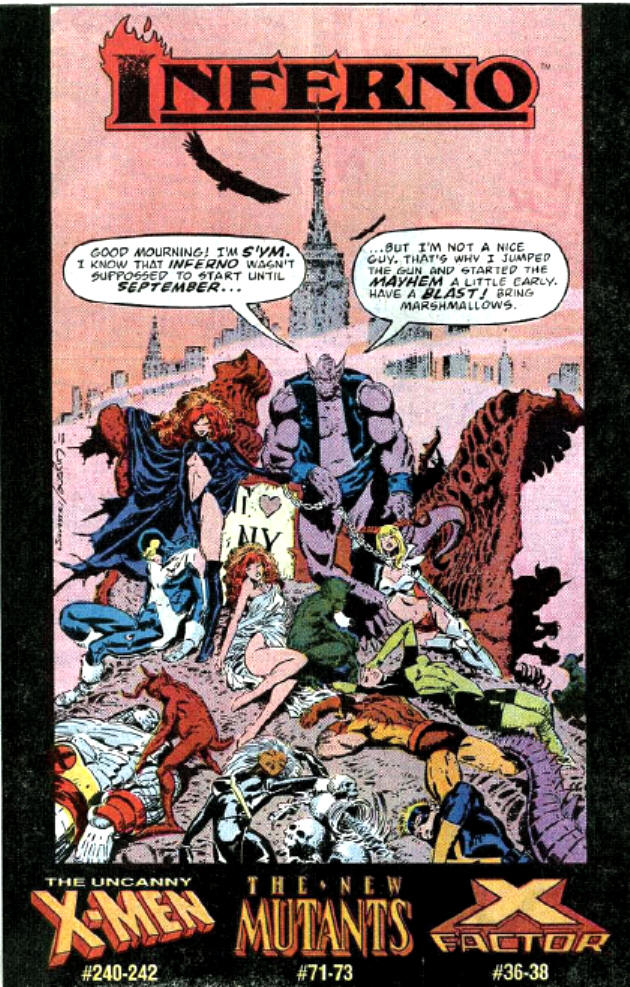
Took Place In: New Mutants 71-73, X-Factor 36-39, Uncanny X-Men 240-243
Written By: Chris Claremont (Uncanny X-Men), Louise Simonson (New Mutants, X-Factor)
Art By: Marc Silvestri (Uncanny X-Men), Jon Bogdanove (New Mutants), Walt Simonson (X-Factor)
Characters Involved: Storm, Wolverine, Havok, Psylocke, Dazzler, Longshot, Rogue, Colossus (X-Men); Archangel, Beast, Cyclops, Nathan Summers (Cyclops’ son), Marvel Girl, Iceman (X-Factor); Cannonball, Mirage, Sunspot, Wolfsbane, Magik, Warlock, Gosamyr (New Mutants) ; S’ym, N’astirh, Crotus (Limbo demons) ; Goblyn Queeen / Madelyne Pryor; Mr. Sinister; Arclight, Harpoon, Sabretooth, Prism, Scalphunter, Malice, Vertigo, Scrambler, Blockbuster, Riptide (Marauders)
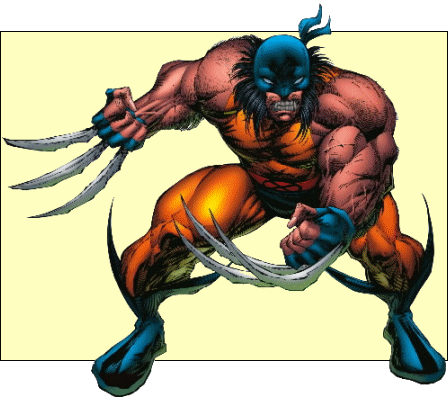
There was a period of time in the 1990’s when Wolverine ‘evolved’ to where his hair was out of control and his nose disappeared. Someone actually thought this was a good idea. I mean, just look at him!
What. The. Fuck.
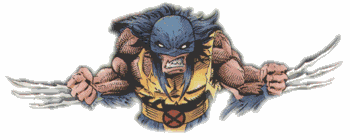
“Grrr! I suck!”
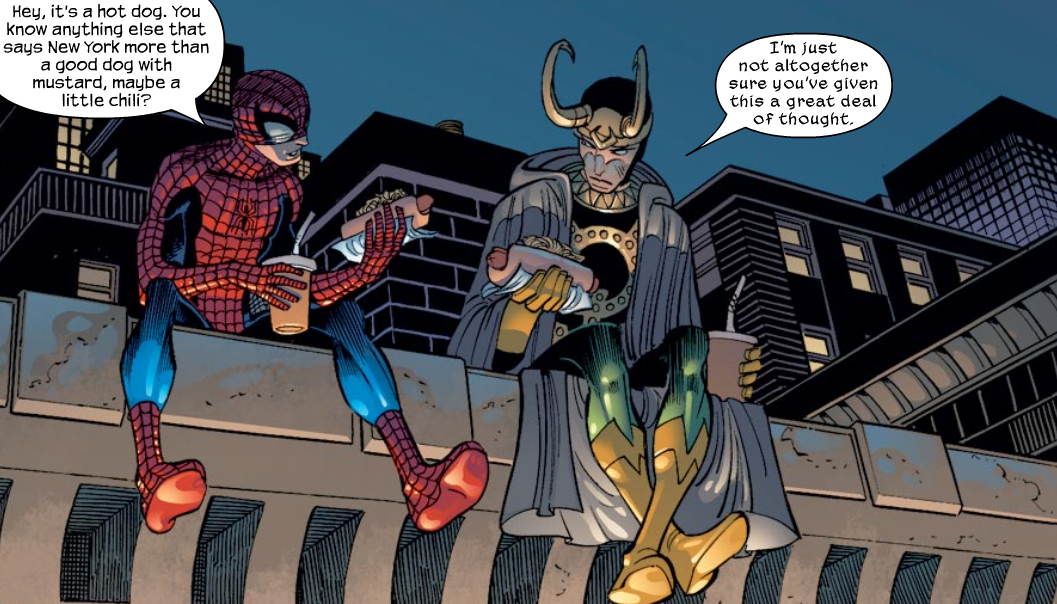
Spider-Man and Loki eating hot dogs together. This actually happened. What the fuck.
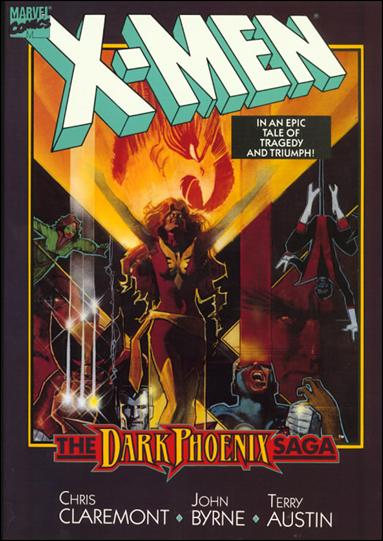
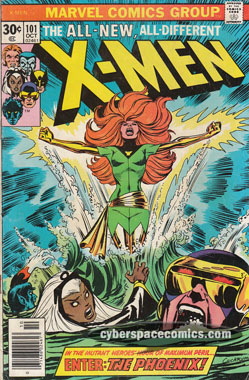
My first exposure to X-Men comics was the Dark Phoenix saga, which many consider to be the greatest X-Men story ever told, even to this day. It was like saying, “Oh, you have a passing interest in trying some really light, social drug? Here, try this crack.” Before this story I would read comics occasionally. Really just whenever I would happen to get some. I never actively sought them out. After this story I wanted everything X-Men I could get my grubby little hands on.
I’m not going to get into too much detail on what came before, since a lot of that has been changed retroactively. But essentially Jean Grey aka Marvel Girl, one of the original X-Men, is imbued with the powers of the Phoenix, a cosmic entity capable of great and terrible things. For a while, Jean seemed ok. Her powers of telepathy and telekinesis were raised to an unprecedented degree, but other than that she was still just Jean.
I’m not the world’s biggest Superman fan. I don’t normally read that many Superman stories, but I tend to gravitate towards the really good ones. There’s something about Superman; I would say that the best Superman stories just feel like there’s something extra special about them compared to any other character. Maybe it’s because he’s the first and the best, but really good creators tend to do their very best work on Superman, whether that’s Grant Morrison, Alan Moore, or whomever.
5. The Death and Return of Superman
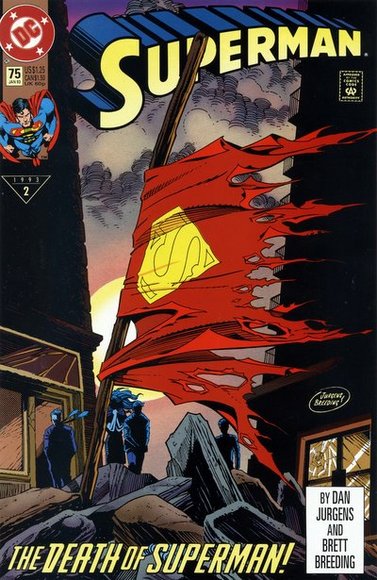
The thing people have to remember about the death of Superman is that nothing had ever hit the public like that from the world of comics. Not only was this story getting mainstream press every week, it was getting a LOT. Air time on Saturday Night Live, the Tonight Show, and pretty much every news show talked about it for quite a while. The creators and editors involved were made into instant pseudo-celebrities. It has since spawned video games, an animated movie, and a ton of stories. Its immediate follow-up, the Reign of the Supermen, created 4 new ‘Supermen’, 3 of which were still prominent figures in DC, at least until the recent line-wide reboot.
So to begin things off the creators introduced Doomsday, an unstoppable killing machine that would be the one to kill the Man of Steel. Doomsday effortlessly cuts a path of devastation across the country until he is confronted by the Justice League. Unfortunately for the League, they are utterly overmatched by Doomsday, even with one of his arms still tied behind his back. Literally. The dude has one of his arms confined behind his back and still punks the JLA out like they were a bunch of rookies.
Hulk smash! I mean, no, wait…
Superman then shows up, and they proceed to destroy the hell out of each other and everything until at last they stop each other. With the last of his strength, Superman unloads everything he has into one last blow, which kills Doomsday. The effort from the punch, combined with the severe damage and injuries sustained during the battle, was just too much, and he dies in Lois Lane’s arms in the middle of the streets in Metropolis.
Long before they were New, Dark, or Disassembled, the Avengers were far from Marvel’s biggest characters. While people liked Captain America, Iron Man, Thor, etc., they weren’t as popular as Spider-Man, the Fantastic Four, or the Hulk. For whatever reason, the Avengers just weren’t striking any chords with the comic book audience as a whole. There were fans, sure, otherwise the title would have been cancelled, but it was never a top seller, and just didn’t garner all that much attention. So it was a bit of a surprise when Roger Stern and John Buscema started a story that has become known as “Avengers: Under Siege”, and all of a sudden everyone was talking about the Avengers.
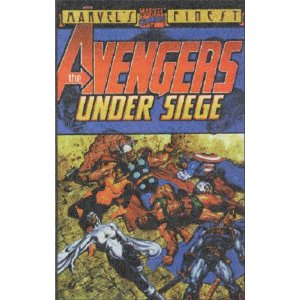
The line-ups for the Avengers have always been in a constant state of change. Each era has its stand-by’s, though. In the 60’s it was mostly Captain America. In the 70’s it was the Vision and/or Hank Pym. By the 80’s it was more B-list characters that usually grabbed the spotlight, like Hercules, the Black Knight, Crystal, or Captain Marvel (Monica Rambeau). The roster when this story opens is Wasp (team leader), Captain America, Black Knight, Hercules, Namor, and Captain Marvel. Also worth noting is the presence of the Avengers mansion’s butler, Edwin Jarvis. Before the Siege, Namor is forced to return to Atlantis to deal with some personal issues, and Hercules, pissed that the Wasp is in charge of him, goes off to get drunk.
In the last part I looked at Geoff Johns’ Avengers, and this part is somewhat similar, in that the writer is also a big name for other projects, and the character is pretty popular.
In the early part of the 2000’s, Marvel launched their Marvel Knights line, which was headlined by Kevin Smith writing Daredevil, with art by Marvel Knights editor/comic artist/eventual Marvel Editor-in-Chief Joe Quesada, which saw Bullseye, Daredevil’s longtime enemy, kill Karen Page, Daredevil’s longtime girlfriend. Following their run was the hugely popular, highly acclaimed run by Brian Bendis and artist Alex Maleev, which saw Daredevil get married to a blind girl named Mila, Daredevil ‘dethroning’ the Kingpin and getting both Kingpin and Bullseye arrested. Oh, it also had Daredevil’s secret identity as blind attorney Matt Murdock revealed to the world. Following up their run would take something special, and maybe just as importantly, someone willing to pick up where Bendis left off, namely having Matt Murdock disbarred and placed in prison for being Daredevil.
Enter: Ed Brubaker. His first arc, ‘The Devil in Cell Block D’, is as good a Daredevil story as you can find.

In part 1 I briefly looked at the X-Men’s first foray into the crossover: the Mutant Massacre, which saw Angel get his wings destroyed, Wolverine fight Sabretooth, Psylocke join the X-Men, Colossus, Nightcrawler, and Shadowcat leave the X-Men. Not normally known for resting on their laurels when they find something that resonates with the fans, Marvel got with the X-office and told them to do another big summer crossover. They ended up giving us…
The Fall of the Mutants
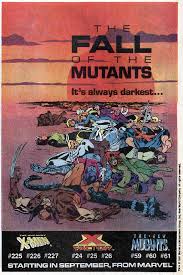
Took Place In: Uncanny X-Men 225-227, X-Factor 24-26, New Mutants 59-61
Written By: Chris Claremont (Uncanny X-Men), Louise Simonson (New Mutants, X-Factor)
Art By: Marc Silvestri (Uncanny X-Men), Walt Simonson (X-Factor), Brett Blevins (New Mutants)
Featured Characters: Colossus, Dazzler, Havok, Longshot, Psylocke, Rogue, Storm, Wolverine, Forge (the X-Men), Cyclops, Beast, Phoenix, Iceman, Caliban, Archangel (X-Factor), Cannonball, Cypher, Magik, Warlock, Sunspot, Mirage, Wolfsbane, Magneto (New Mutants), Avalanche, Blob, Crimson Commando, Destiny, Mystique, Pyro, Spiral, Stonewall, Super Sabre (Freedom Force), Apocalypse and his four Horsemen, Cameron Hodge, the Adversary
DC Comics has pretty much always been about changing things up. They rebooted their entire line more than a few times, they have replaced beloved characters with ones nobody cared about, they have dragged their icons through the mud on numerous occassions. They’ve let titles like JLA, JSA, and Teen Titans spend so much time floundering that it should be considered criminal. But there are a few things they’ve done over the years that drove me crazy, and I was able to narrow it down to the 5 most glaring (to me). Keep in mind that these aren’t the 5 worst moves DC has ever made, but the ones that I disliked the most. So, in no particular order….
1.Final Crisis
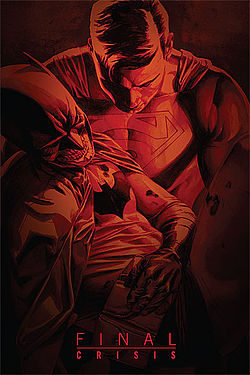 DC has always had this thing that they do. First, they lose control of how streamlined their universe is. Then, they compound the problem by adding retcons, and new characters replacing old ones, and revamps. Then, realizing that this has left a bigger mess, they have a “Crisis” and come out of it with a new universe. After the first, “Crisis on Infinite Earths”, Supergirl and the Flash were dead (among others), and they relaunched their books (or at least their characters) with new origins, and the previous decades of stories no longer ‘counted’. Then, about ten years later, the same problem had happened. They had lost control of their universe, and the titles were suffering. Rather than doing the Marvel (aka ‘smart’) thing, namely getting top talent on your titles and telling them to go nuts, DC decided the real problem wasn’t the way the books were being made, but rather that they just all needed new blank slates (again). So there was “Zero Hour”, which led to the deaths of a lot of people, most notably the Atom, Hourman, and Dr. Midnite from the JSA. After Zero Hour everything was rebooted (AGAIN). Cut to 15 years later, and DC is doing pretty darn well. Their books are as good as they’ve ever been, they have A list creators working for them, and they’re exploring movie options for a number of them. But still, they decided they needed a clean start (albeit not a complete reboot, more like a… restructuring), so along came “Infinite Crisis”, which didn’t so much reboot everything as it let them fix some continuity problems that they had. It actually made the entire line stronger, but that wouldn’t last…
A few years later DC has squandered almost all of the good will they had built with fans from projects like Identity Crisis, Infinite Crisis, 52, etc. After “Countdown”, and the mind-boggling handling of the Flash, the Justice League, Superman, and the Teen Titans, DC decided it was time once again to have a crisis. Enter Grant Morrison and Final Crisis, a story about what happens to the Earth when gods from another planet start to manifest here. While that’s a cool story idea, the execution was, to say the least, flawed. Rather than a straightforward story, we got a metaphysical wankfest from Morrison, who had much more interest in writing about the strength of myths and stories rather than any kind of ACTUAL story. It was a huge mess, and really killed any momentum that was left from the Infinite Crisis days.
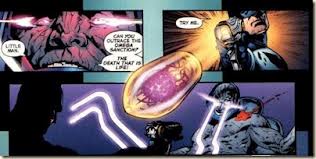
Not only was the story a mess, but it was completely forgettable. It had no real lasting effect on any of the DC titles, not even Batman, who ‘died’ in Final Crisis. Well, that is if you read Final Crisis. If you were just reading Batman, it was clear that SOMETHING happened to him, but damned if anybody could figure it out. Not that it was some super-well written mystery, but it just didn’t make any damn sense. Finally, the fans started to speak with their money, and started dropping DC titles like they were made of dead babies and AIDS. This led to Warner Bros, DC’s parent company, to do some corporate restructuring, including bringing in Bob Harras as the new Editor-in-Chief. Bob was once the EIC at Marvel, and promptly ran them into bankruptcy. As soon as he was in charge at DC we saw him implement HIS idea for how DC should reboot (again. For the THIRD time in less than 10 years)…..
Continue reading
 Comic Zombie